For nearly a hundred years, finding a new Nazca figure meant a person, on foot or in a small plane, scanning the same bone-dry plateau in southern Peru inch by inch, hoping a faint scrape in the desert varnish would resolve into a shape. That method found about 430 figurative geoglyphs. It took generations.
Then a research team fed the desert to an AI, and in a single field season, the count nearly doubled. But the number of new figures was never the real story. Where the machine kept pointing was.

Quick Facts
| Subject | AI-assisted discovery of new Nazca geoglyphs |
| Previously known | ~430 figurative geoglyphs, found over nearly a century |
| Newly confirmed | 303 figurative geoglyphs, in roughly six months (2022–2023 field season) |
| Team | Masato Sakai (Yamagata University, Japan) with IBM Research and Peruvian researchers |
| Published | PNAS, September 2024 |
| Key finding | New figures cluster along ancient footpaths — sized to be seen up close, not from the sky |
What We Were Told
The Nazca Lines have spent decades wrapped in one particular myth: that they were made to be seen from above, by gods, by spirits, or — in the more fringe tellings — by visitors who arrived from somewhere else entirely. It’s an appealing story precisely because it’s unfalsifiable from the ground. You cannot see a hummingbird the size of a football field by standing next to it.
That was the story. But that’s not the whole story.

What Was Found
Sakai’s team trained an AI on the roughly 430 known figures and set it loose on high-resolution aerial imagery of the pampa, hunting for faint anomalies too subtle or too fragmented for the human eye to flag efficiently. The AI didn’t discover anything by itself — it narrowed hundreds of square kilometers down to a manageable list of promising locations. Archaeologists still had to walk out to each one and confirm it by hand.
In roughly six months, that partnership confirmed 303 new figurative geoglyphs — sixteen times the rate at which they’d been found for the previous hundred years.
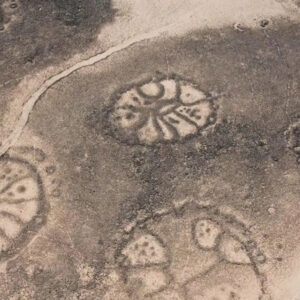
The new figures include human forms, decapitated heads, camelids and other domesticated animals, felines, birds, and scenes that appear to show people interacting with animals. One stood out immediately: a killer whale gripping a knife-like object. Sakai’s team didn’t have to guess at the meaning — Nazca pottery from the same period already shows orcas wielding blades over human heads. The geoglyph wasn’t a new idea. It was a known motif, rendered at ground scale.
The Detail That Changes Everything
Here is the part the headline numbers don’t capture: the new figures fall into two distinct categories, and they don’t behave the same way.
The famous giant animals — the ones tourists fly over — are “line-type” figures: large, embedded in a wider network of geometric lines and trapezoids, the kind of scale that only makes sense from the air or from a processional route built specifically to reveal them. The 303 new discoveries are overwhelmingly a different category entirely: “relief-type” figures, small, mostly depicting humans and domesticated animals, and — this is the detail — they cluster tightly along what appear to be ancient walking trails.
Not scattered across the empty pampa. Lined up along the paths people actually used.

The Central Mystery
If a figure is small enough to see clearly only from a few meters away, and it’s placed exactly where people were already walking, it was not made for a god in the sky, and it was almost certainly not made for anyone hovering above the desert at all. It was made for whoever was walking that trail, at the moment they walked past it.
Which raises the question the “ancient astronaut” framing never had to answer: who were the Nazca making art for at ground level, right where ordinary foot traffic already passed — and why did that population need to see it there, specifically, instead of anywhere else?
Competing Theories
Theory one — waypoints on a pilgrimage route. The relief-type figures may have marked stages along a processional or ceremonial path, guiding travelers toward a shared ritual destination.
Theory two — social or territorial signaling. Placed where foot traffic between communities was guaranteed, the figures may have functioned like messages — declarations of identity, status, or belonging — aimed squarely at other people, not at the sky.
Theory three — practical and ceremonial at once. The distinction between “line-type” and “relief-type” may reflect two different purposes running in parallel: monumental animal figures for larger, possibly communal ritual, and smaller trailside figures serving a separate, everyday function — landmarks or storytelling along a route people walked regularly.
No one can say for certain which purpose dominates. And that may be the point.

Why It Still Haunts Us
Nearly a century of dedicated searching produced 430 figures. Six months of machine-assisted survey produced 303 more — and, more importantly, produced a pattern no one had been able to see at scale before: some Nazca art was never meant for the heavens at all. It was meant for the person walking the trail, close enough to touch it.
Sakai’s team estimates roughly 250 more figures may still be hidden across the pampa, and a later 2025 presentation has already floated further finds awaiting full peer review.

If part of the most famous “message to the sky” in archaeology was never aimed at the sky at all, how much of the rest of it have we been reading upside down?
Sources & further reading: Sakai, M. et al., “AI-accelerated Nazca survey nearly doubles the number of known figurative geoglyphs and sheds light on their purpose,” PNAS, September 2024 (DOI: 10.1073/pnas.2407652121); Yamagata University press release, Sept. 24, 2024; Smithsonian Magazine; National Geographic.